
Window awnings improve comfort by stopping the sun's heat before it reaches the glass. This simple principle has been used for centuries and remains one of the most effective passive cooling strategies available today.
Why Awnings Work
Two Foundational Principles
01/ Windows Are the Primary Pathway for Solar Heat Gain Inside
Research has consistently shown solar radiation through windows is the largest contributor to heat gain in buildings. Heat from the sun entering through roofs, walls, doors, and air infiltration is significantly smaller. Reducing unwanted heat gain begins at the window.
When sunlight passes through window glass the solar radiation enters as short-wave radiation, it is absorbed by interior surfaces, and emits heat back as long-wave radiation, which cannot escape back out through the glass, trapping the warmth inside.
02/ The Greenhouse Effect is Real
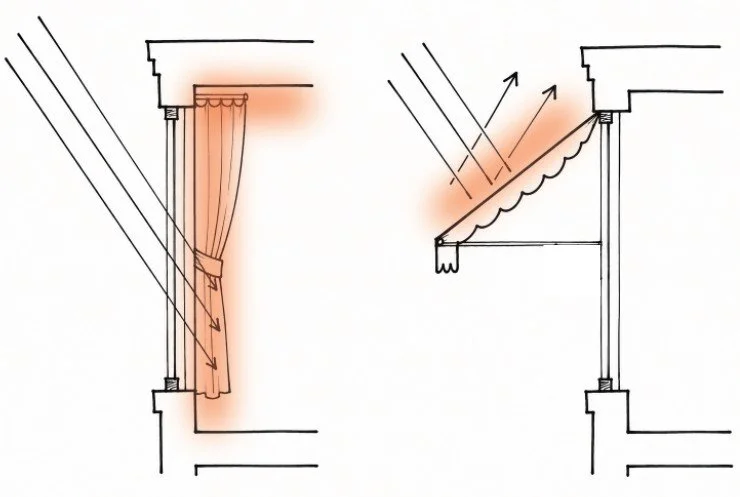
Stop the heat before it enters to avoid the greenhouse effect!

It is not surprising that before we had air conditioning, awnings were widely adopted throughout New York City and well beyond to dramatically improve thermal comfort.
Photo: Morningside Avenue, Harlem / Courtesy Greater Astoria Historic Society
Proven Performance
By interrupting the greenhouse effect at the window, the U.S. Department of Energy provides a more exact number on the results:
-65%
Solar Heat Gain Reduction on South-Facing Windows
U.S. Department of Energy
-77%
Solar Heat Gain Reduction on West-Facing Windows
U.S. Department of Energy
Because less heat enters the building, the air conditioner doesn't have to work as hard. This reduces energy use by lowering the building's cooling load. Building scientists have placed an approximate number on this energy savings:
-15%
Cooling Load Reduction with Awnings in Closed Position from April to September
Is your building a good candidate?
Next Step